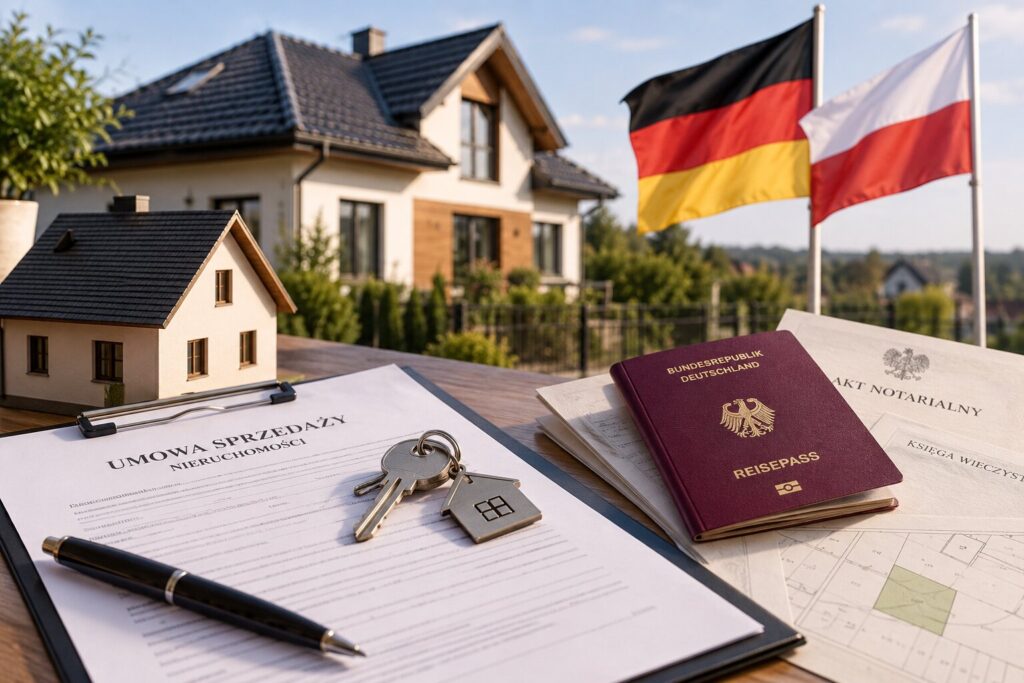
Does a German citizen need a permit?
Germany is part of the European Economic Area. According to the Polish Ministry of the Interior and Administration and the Act on the Acquisition of Real Estate by Foreigners, a German citizen generally does not need a permit to acquire real estate in Poland. This principle applies regardless of the property’s location and area.
However, each transaction still requires a document review. Particular care is needed where the house stands on agricultural land, because separate restrictions may apply.
The key exception: agricultural land
The National Support Centre for Agriculture explains that acquiring agricultural real estate of at least 1 hectare by an entity not covered by statutory exceptions may require consent from the Director General of the Centre. Before proceeding, the buyer should establish the legal status of the plot and review its planning designation.
An application for consent may require the buyer’s and seller’s details, plot identification, an extract from the land register, land and mortgage register documents, information about the local plan and an explanation of the intended purpose of the acquisition.
Documents and checks before signing
- Identity document: prepare a valid document confirming the buyer’s identity and the details required for the notarial deed.
- Land and mortgage register: review the documents concerning the property and the rights recorded against it.
- Land status: establish whether the plot is agricultural and whether its area or designation creates additional requirements.
- Foreign-language documents: certified translations may be needed for documents submitted in a procedure.
For an initial search, buyers can review houses for sale in Poland and then compare local listings, including houses in Szczecin or houses in Warsaw. Listings do not replace legal due diligence.
The notarial deed and interpreting
Transfer of ownership of real estate requires a notarial deed. If the buyer does not understand Polish, the notary should provide a translation of the deed or document personally or with the assistance of an interpreter. A deed concerning a foreign buyer also includes information about the buyer’s citizenship.
After the deed is signed, the notary submits an application for entry of the right in the land and mortgage register through the electronic system. It is sensible to confirm in advance which details and documents the notary needs and whether an interpreter must attend.
PCC on a house purchase
The Ministry of Finance states that the sale of real estate, including ownership rights to a single-family house, is generally subject to a 2% civil law transactions tax when the transaction is not subject to VAT. For an agreement concluded before a notary, the notary collects the tax. Specific rules may apply to an exemption for a first house or apartment purchased on the secondary market, so the buyer’s circumstances should be checked before signing.
A practical sequence
- Select the property and collect basic information about the house and plot.
- Check the land and mortgage register, land records and agricultural status.
- Ask the notary whether the EEA exception applies and which documents are required.
- Arrange an interpreter if the buyer does not understand Polish.
- Sign the notarial deed and verify that the application for registration has been submitted.
- Confirm with the notary whether PCC is payable.
Disclaimer: Information about procedure, tax and agricultural-land restrictions is general and does not replace individual advice from a Polish notary, lawyer or tax adviser.